


More people are turning to AI tools like ChatGPT when researching businesses, services and products. Instead of only searching Google, they might ask, “Can you recommend a web design agency in Leicester?” or “Who are the best accountants near me?”
That means businesses now need to think about more than traditional search rankings. They also need to consider how easily AI can understand what they do, recognise their expertise and decide whether they are a credible recommendation.
So, how do you get your business recommended by ChatGPT?
There is no guaranteed trick or shortcut. Instead, you need to build a strong online presence that gives AI tools plenty of useful, trustworthy information about your business.
This guide explains how AI recommendations work and the practical steps you can take to improve your visibility through AI search optimisation.
How Does ChatGPT Recommend Businesses?
AI recommendations work differently from traditional Google search results. Rather than simply listing websites, AI tools can understand a question, consider the context and, where web search is available, find information from relevant sources before creating an answer.
For example, someone might ask:
“I’m a small business in Leicester looking for a new website. Can you recommend a few web design companies?”
ChatGPT needs to understand the service, location and type of business involved before deciding which companies may be relevant.
The same applies to other industries. Someone looking for an electrician might ask: “Can you recommend a reliable electrician in Leicestershire for a commercial property?” Or an individual could ask: “Who are the best accountants for a small business in Leicester?”
The clearer the information available about a business, the easier it is for AI tools such as ChatGPT to understand where that business fits.
This is why AI search optimisation is becoming increasingly important. Your online presence needs to clearly communicate what you do, who you help, where you operate and why customers should trust you.
If you want help improving your visibility, our AI search optimisation service can help.
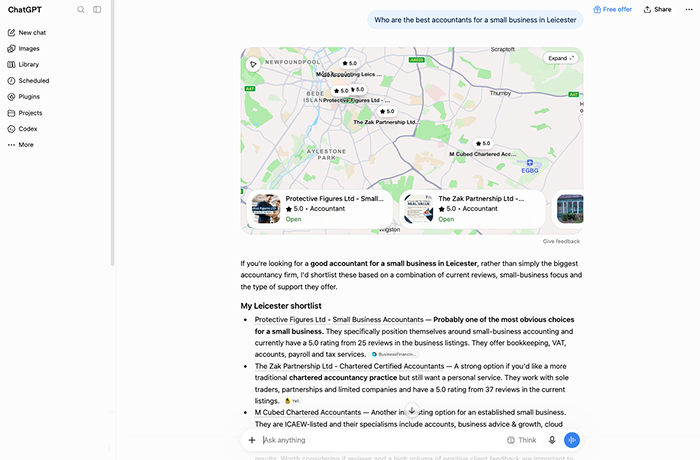
AI Recommendations Aren’t Fixed Rankings
One important difference between Google and AI search is that there is not always a fixed number one position.
Ask an AI tool the same question more than once and the recommendations can change. Different wording, locations, requirements and sources can all influence the answer.
Rather than trying to “rank number one” in ChatGPT, it is more useful to look at how often your business appears across a range of relevant questions.
Over time, this gives you a better sense of whether AI tools understand your business well enough to recommend it.
How to Get Your Business Recommended by ChatGPT
There is no single action that guarantees an AI recommendation. Instead, focus on building a digital presence that makes your business easy to understand, trust and find.
1. Make It Clear What Your Business Does
Start with the basics. Your website should make it immediately obvious what your business does, who you work with and where you are based.
Avoid relying on vague marketing language. If you are a commercial electrician in Leicester, say so clearly. If you are an accountant specialising in small businesses in Market Harborough, make that clear too.
Your homepage and key service pages should explain your services in plain English, while your location should be naturally included where it is relevant.
It is also important to keep your business information consistent across your website, Google Business Profile, social media and relevant directories.
Think about the information an AI tool would need to confidently describe your business to someone else. If your website makes it difficult to work out what you actually do, you are making that job harder.
2. Keep Your Core Information Up to Date
Future-proofing also means keeping the basics current. If your services change, your team changes or your location changes, your website and other key profiles should change too. Old information can stay visible for longer than many businesses expect.
A simple review process can make a big difference. Check your homepage, service pages, About page, business profile and major directory listings regularly so they continue to match the business you want AI to understand and recommend.
3. Optimise Your Google Business Profile
For local businesses, your Google Business Profile should be a key part of your AI search optimisation strategy. Make sure your profile is complete, accurate and regularly maintained. Check your:
- Business category
- Services
- Opening hours
- Photographs
- Website address
- Contact details
- Business description
Your Google Business Profile also provides an important opportunity to build your reputation through genuine customer reviews.
Keep your information up to date, add regular updates and continue encouraging happy customers to leave honest reviews.
Customer reviews show experience and sentiment, while citations and third-party mentions confirm that your business is established and visible across the web. Together, they create the kind of external validation AI tools can trust.
4. Answer the Questions Your Customers Actually Ask
One of the biggest opportunities for AI search optimisation is creating content around genuine customer questions.
Think about what people ask before deciding whether to buy from you. An electrician could answer:
- How much does it cost to rewire a house?
- How often should commercial electrical systems be inspected?
- What is an EICR and who needs one?
An accountant could cover:
- When should a small business register for VAT?
- What does an accountant actually do for a limited company?
- Do I need an accountant if I’m self-employed?
The aim isn’t to create content simply because a keyword has search volume. Instead, think about the conversation your customer is having before they contact you.
A common mistake is publishing broad, vague content and expecting AI tools to infer the details. If your website relies on general marketing language, AI may struggle to understand what you actually do, who your customers are and why you are a good match.
Clear, specific language is far more effective than polished but empty copy, and it benefits both SEO and AI search.
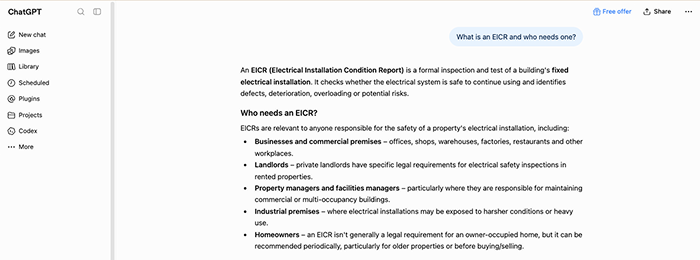
5. Create Comparison and Decision-Making Content
People often use AI when comparing different options, so comparison content can be particularly useful.
For example, a web design agency could answer questions such as:
- WordPress vs Shopify
- SEO vs Google Ads
- Local SEO vs national SEO
An accountant might compare:
- Sole trader vs limited company
- In-house bookkeeping vs outsourced bookkeeping
- Cloud accounting software options
The important thing is to make these comparisons genuinely useful rather than turning them into a sales pitch.
Explain the advantages and disadvantages of each option and who each solution is best suited to. This demonstrates expertise and helps potential customers make a more informed decision.
Comparison pages can be especially useful because they reflect the way customers actually make decisions. But they should not be left untouched once they are published. Review them regularly so they stay accurate as competitors, service features and customer expectations change.
6. Show Evidence of Your Expertise
Don’t just tell people that you’re experienced or that your service gets results. Show them.
Include on your website relevant case studies, customer results, statistics, examples and genuine testimonials. These can all make your content more useful and credible through clear evidence.
For example, instead of an electrician simply saying, “We provide a reliable commercial electrical service,” they could explain a recent project, the problem the customer had, how it was resolved and the outcome.
A kitchen company could explain how a difficult layout was redesigned to create more usable space. An accountant could discuss common financial mistakes they see among small businesses.
Your own experience is valuable too. If you’ve worked with many customers and repeatedly come across the same problems, share what you have learned.
7. Build Your Reputation Across Multiple Areas
AI tools can encounter information about your business through reviews, directories, industry websites, news articles, social media and other third-party sources.
That means it is worth looking for relevant opportunities to have your business mentioned elsewhere online. Reviews, citations and independent mentions help confirm that your business is real, relevant and trusted.
When those sources consistently support the same services, location and expertise, AI tools have a stronger basis for recommending you.
For local businesses, this could include:
- Local publications
- Business organisations
- Industry directories
- Regional press
- Relevant professional organisations
- Industry websites and publications
The aim isn’t to get your business mentioned everywhere. Relevant, credible mentions are much more useful than creating dozens of low-quality listings. A review on a trusted industry site, a mention in a respected publication, or a listing in a credible directory is usually more useful than a random mention on an unrelated site. The goal is to build a public record that reinforces your authority in the right market.
8. Keep Your Website Technically Strong
Good content is important, but don’t overlook the technical side of your website. Your website should be:
- Fast and easy to use
- Mobile-friendly
- Simple to navigate
- Clearly structured
- Accessible to search engines
It is also worth checking whether your website allows relevant AI crawlers to access your content if you want that content to be discoverable through AI-powered search.
Good technical foundations won’t automatically get your business recommended by ChatGPT, but they do make it easier for search engines and AI systems to discover and understand your content.
How Can You Measure Your AI Search Visibility?
One of the biggest challenges with AI search is that there isn’t a traditional ranking position to monitor. Instead, create a list of questions your potential customers might ask and test them regularly.
For example, a Leicester electrician could monitor:
- Who are the best electricians in Leicester?
- Can you recommend a reliable electrician in Leicestershire?
- Which electricians specialise in commercial electrical work in Leicester?
- What should I look for when choosing an electrician in Leicester?
An accountant could create a similar list around accountancy services.
Record whether your business appears, which competitors are mentioned and how the AI describes your company.
Over time, this gives you an indication of your share of mentions across relevant searches.
You can also monitor your website analytics for referral traffic from AI platforms and look out for enquiries from customers who say they found you through ChatGPT or another AI tool.
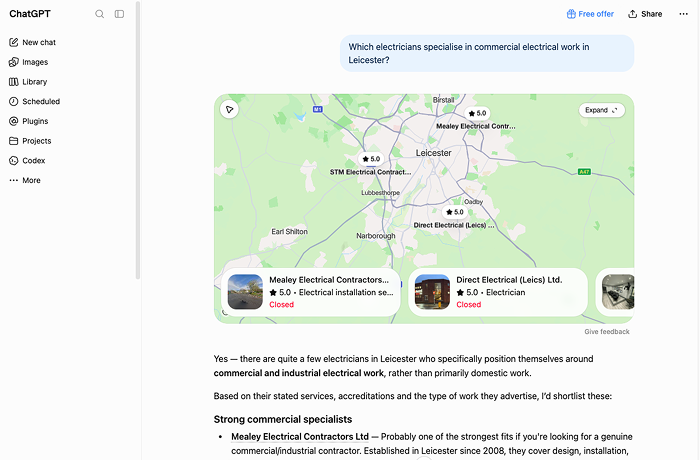
How To Future-Proof Your AI Visibility
AI search is still developing, which means the way businesses are discovered and recommended will continue to change.
That is why future-proofing matters. The goal is not to chase every new tactic or respond to every small change. It is to build a digital presence that stays clear, credible and useful even as AI tools evolve.
The businesses most likely to stay visible over time are the ones that treat AI visibility as an ongoing system, not a one-time project. They keep their key information accurate, update their proof regularly and make sure their website and wider online presence continue to reflect what they actually do.
If your content is structured well and your evidence is strong, you are much better placed to adapt when AI platforms start prioritising different signals.
Is AI Search Optimisation Replacing SEO?
No. AI search optimisation is best seen as an extension of SEO rather than a replacement for it.
A strong website, useful content, technical SEO, local SEO, reviews and relevant backlinks can support both traditional search and AI visibility.
The difference is that AI search adds another consideration: Can an AI system clearly understand your business and recognise why you could be a good recommendation?
This is why we don’t recommend abandoning your existing SEO strategy and chasing every new AI tactic.
Instead, improve the foundations that already make your website useful to both search engines and customers.
Build a Business Worth Recommending
There is no magic formula for how to get your business recommended by ChatGPT.
You cannot guarantee that an AI tool will mention your company, and trying to manipulate the system with keyword stuffing or fake reviews isn’t the answer.
Instead, focus on becoming a business that is genuinely easy to recommend.
Be clear about what you do. Answer the questions customers ask. Demonstrate your experience. Build genuine reviews. Earn relevant third-party mentions. Keep your website technically strong.
Do that consistently and you will improve both your AI visibility and your overall online presence.
FAQs About How to Get Your Business Recommended by ChatGPT
How do I get my business recommended by ChatGPT?
There is no guaranteed way to make ChatGPT recommend your business. The best approach is to build a strong online presence with clear website content, accurate business information, genuine reviews and relevant third-party mentions.
What is AI search optimisation?
AI search optimisation is the process of improving your online presence so AI-powered search tools can better understand your business, services, expertise and location.
Does ranking highly on Google mean ChatGPT will recommend my business?
Not necessarily. Google rankings remain valuable, but AI recommendations can consider information from a wider range of sources and can change between searches.
Do Google reviews help with AI search optimisation?
Yes. Genuine reviews contribute to your overall online reputation and provide evidence of your service quality.
Should I create blogs specifically for ChatGPT?
Not necessarily. Instead, create useful content that answers the questions your customers genuinely ask.
How can I check whether ChatGPT recommends my business?
Test the questions your customers might ask and record whether your business appears, which competitors are mentioned and how your business is described.
How Can We Help?
AI-powered search is changing how people research businesses, but the fundamentals still matter.
Create useful content. Be clear about what you do. Build your reputation. Keep your information accurate. Demonstrate your expertise.
Do that consistently, and you will make your business easier for AI tools to understand and recommend. If you need support with this, our AI search optimisation service can help.
Get in touch with one of our team to see how we can help your business get recommended by ChatGPT.
Ben Webster
Creative director at 1PCS. Addicted to design, SEO, pizza and helping companies big and small succeed online.